I was at the arboretum for a tour this morning, and when it was over, I was doing a little bug-hunting. I heard something scuttling in the leaf litter under a tree. It figured it was a lizard, because we have lots of lizards, and the weather is warm enough that they are still active. But as I sought out the source of the scuttling sound, what I saw didn’t move quite like a lizard. A mouse perhaps? I thought I saw a pair of beady eyes before it submerged itself in the leaves. I waited a bit. The leaves began to twitch as the creature surfaced again. It was a lizard, with its entire head stuck fast inside what looked to be a palm kernel shell! I picked up the lizard, and pulled gently on the shell. There was no way I could pull it off without wringing the reptile’s neck. There was no telling how long it may have been stuck, but I didn’t want to leave it to suffer for days or even weeks before it slowly died of thirst. So I brought it to the attention of a couple of the garden staff working nearby, Greg and John. They were appropriately impressed by the lizard’s predicament, and immediately began brainstorming about the best way to remove the shell, which was smaller than a golf ball, but extremely hard, like a coconut shell.  I tagged along (I found the lizard, after all) and we all went to the service yard, where an array of tools were available to try to crack the shell without cracking the poor lizard’s tiny skull! First they put it in a vice, but the roundness of the kernel made it hard to tighten without it shifting around in the clamp. I suggested that maybe we could use a drop or 2 of olive oil and "lube" it free, much as a person might work a too-tight ring off their finger. I don’t know if there was even any olive oil in the arboretum’s little kitchen, and I didn’t want to chance using soap on a lizard, but it didn’t matter, because the guys had already moved on to the next piece of hardware: a hacksaw.  Carefully and slowly, John sawed on the tough kernel shell with one hand as he held the lizard in his other hand. Every few seconds he would stop and check the progress of the shell. It was slow going. The lizard was squirming a little, but not as much as I was! Finally, the saw just barely broke through, but the shell was still intact. The next step would be to hold a chisel in the cut and tap it with a hammer. They set the lizard down, held its captive head steady and began tapping, tapping…. Suddenly the kernel shell gave way and split apart, and in that same instant the lizard dashed across the yard at an incredible speed. I don’t think I’ve ever seen a lizard move that fast! We all thought we might have seen something on its head. Whether it had been injured, or whether it was just a bit of shell still stuck on its head, we will never know because that little guy just kept running, but the fact that it could run so dang fast was encouraging.  Tools, empty shell halves and a long-gone lizard. |
October 31, 2008
An unlucky lizard's lucky day
October 28, 2008
The end, for one mantid

This male S. californica had been hanging around my front
porch light for the better part of a week. I'm not sure, but
I'd like to hope he was at least feeding on the various moths
and bugs that come each night. But I think he had never
found a mate, got distracted by the light, and ultimately
didn't have the "oomph" to go anywhere else. This morning
I checked and did not see him, only to discover soon after
that he had somehow managed to get in the house. I picked
him up. He was clearly weak. I carried him outside, put him
on a plant and sprayed him liberally with water.
porch light for the better part of a week. I'm not sure, but
I'd like to hope he was at least feeding on the various moths
and bugs that come each night. But I think he had never
found a mate, got distracted by the light, and ultimately
didn't have the "oomph" to go anywhere else. This morning
I checked and did not see him, only to discover soon after
that he had somehow managed to get in the house. I picked
him up. He was clearly weak. I carried him outside, put him
on a plant and sprayed him liberally with water.
I just checked on him. He is dying. He will probably not
survive the night.
survive the night.

Lefty, the tiny mantid I collected last week, is still doing well.
I'll post some pictures after he sheds his skin, which should
be soon.
Tags:
October 24, 2008
Mantis on bark
I found this pretty S. californica girl on the trunk of a pine tree.
I just loved her brown coloring.

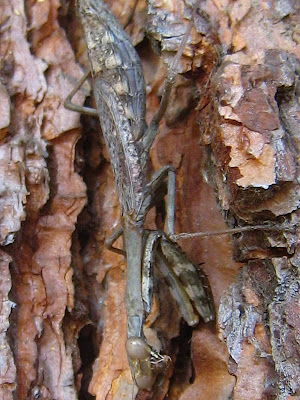

Looking at you looking at me.
I just loved her brown coloring.


Looking at you looking at me.
Tags:
Mellow Yellow grasshopper fellow
This grasshopper nymph made my day today.
He's so yellow! Definitely the yellowest grasshopper
I've ever seen. Not that his color suprises me.
These gray bird nymphs can be just about any color.


Although he was hanging out on this Society Garlic bloom,
there were Milkweed plants and some other things nearby
that had yellow on them, but I'm not really sure where he
was feeding and where he got that color from.
He's so yellow! Definitely the yellowest grasshopper
I've ever seen. Not that his color suprises me.
These gray bird nymphs can be just about any color.


Although he was hanging out on this Society Garlic bloom,
there were Milkweed plants and some other things nearby
that had yellow on them, but I'm not really sure where he
was feeding and where he got that color from.
Tags:
Small bug

Looked like a teeny-tiny relative of a harlequin bug.
Seen on the side of my garage.
Seen on the side of my garage.
Update: Identified as Bagrada hilaris. An African pest
species just recently "discovered" in California.
species just recently "discovered" in California.
Tags:
Follow the signs (and arrows)
This morning I was at the arboretum, scouting for bugs for
this weekend's Bug Safari, (the last scheduled Bug Safari of
the year.) While scanning the passiflora for Gulf Frittilary
caterpillars, I came upon a conspicuous trailing line of spider silk.
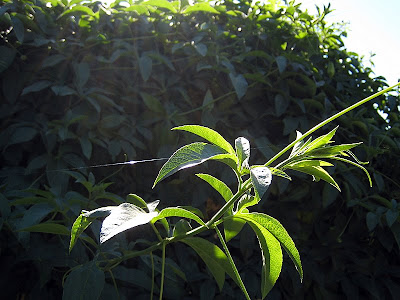
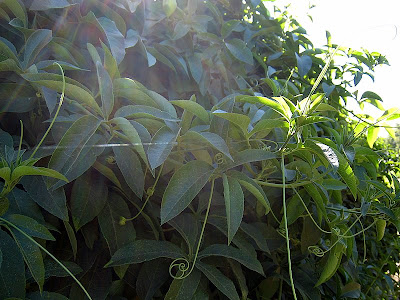
I followed it a little way...
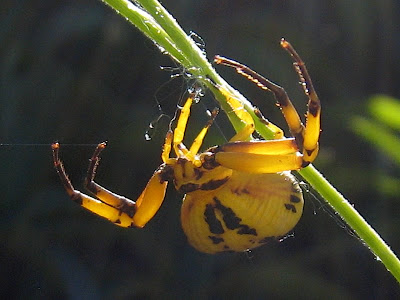
... and it led me to this beautiful creature.
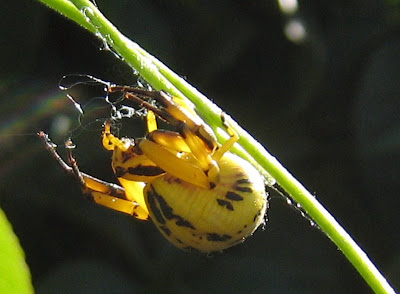
She was reeling in her silk line. I think she was eating it.
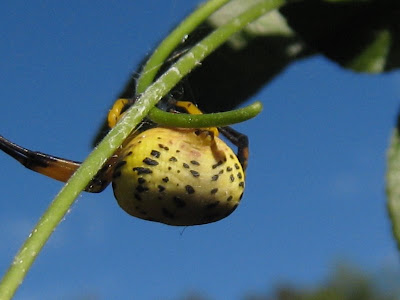
She had an enormous bum! Full of eggs, I'll bet.
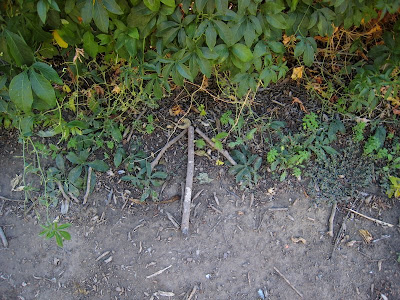
I marked the spot on the trail with an arrow of twigs.
I do this occasionally so I can try to re-find the bug in
question at a later date. Crab spiders usually stay within
in a small territory, as long as food is available.
this weekend's Bug Safari, (the last scheduled Bug Safari of
the year.) While scanning the passiflora for Gulf Frittilary
caterpillars, I came upon a conspicuous trailing line of spider silk.


I followed it a little way...

... and it led me to this beautiful creature.

She was reeling in her silk line. I think she was eating it.

She had an enormous bum! Full of eggs, I'll bet.

I marked the spot on the trail with an arrow of twigs.
I do this occasionally so I can try to re-find the bug in
question at a later date. Crab spiders usually stay within
in a small territory, as long as food is available.
Tags:

One last organic veggie stowaway

Found this little guy deep inside a head of organic lettuce.
He had been in the fridge for a few days. He was dead
Tags:
October 22, 2008
Just a few more spiders....
Some brown widow spiders at the arboretum this week.
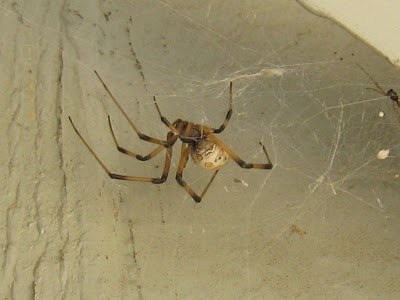
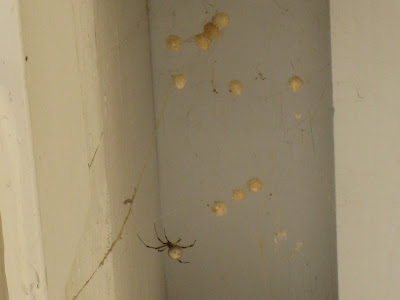
This one, living under the Pavillion roof, seemed to have had
a very productive life, by the look of all those egg sacs.
Or should I say reproductive?
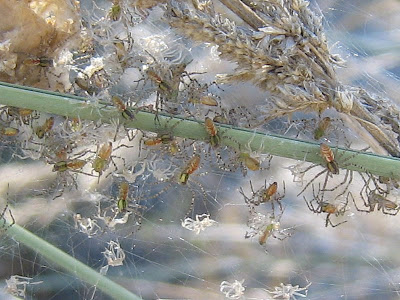
I came upon a family of green lynx spiderlings, all proudly
showing off their discarded exoskeletons. The momma was
nowhere in sight.
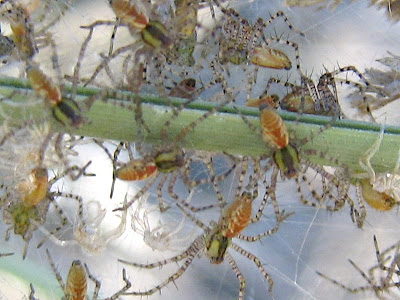
At this size, they're not even hideous. They're cute. I wonder,
though, why nature makes them hatch in the fall, when they
must spend their childhood living through a season of cold,
wet weather and much fewer bugs than they would find in the
rest of the year.


This one, living under the Pavillion roof, seemed to have had
a very productive life, by the look of all those egg sacs.
Or should I say reproductive?

I came upon a family of green lynx spiderlings, all proudly
showing off their discarded exoskeletons. The momma was
nowhere in sight.

At this size, they're not even hideous. They're cute. I wonder,
though, why nature makes them hatch in the fall, when they
must spend their childhood living through a season of cold,
wet weather and much fewer bugs than they would find in the
rest of the year.
Compost critters

Big beetle grubs are tunneling through my compost.
Every time I add stuff to it, or mix it up, I end up digging a few up.


These are just hideous. Not even handsome-hideous
like a spider. Just plain ugly.

Swept away

This is truly the peak, or maybe just past the peak of spider
season. They are absolutely everywhere. Sadly, I haven't seen
nearly enough of the big orb-weavers, but there have been lots
of widows, black and brown. This is a black widow male who
had made a nice home for himself right over our front door.
At Michael's urging, I got rid of him, but not before taking his
picture several times. The yellow stuff is my broom.

The hour glass.


He really was a handsome fellow. In a hideous sort of way.

October 20, 2008
Cute but pesty

This cute little fellow is the 3 lined potato beetle, Lema daturaphila.

They can really chew up a plant.


A few mantid shots
I've been seeing loads of mature mantids lately, mostly at the arboretum, but a few around my house, too. I don't know why I keep taking pictures of them. Sometimes even I feel like if I've seen one, I've seen them all. But all to soon they will be gone, so I still say "hello" to every one I see, and take their picture if I have a chance.
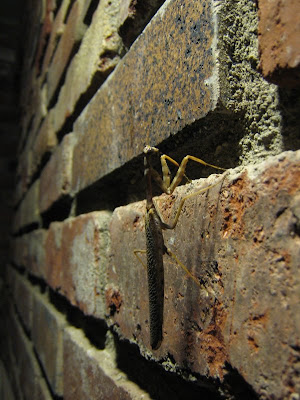
Here's a male S. Californica that came to my porch light.
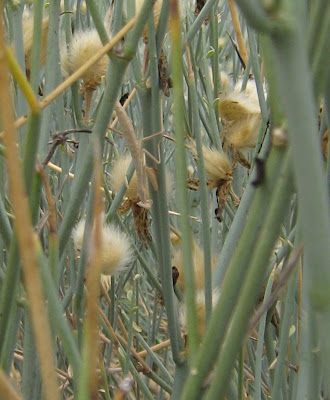
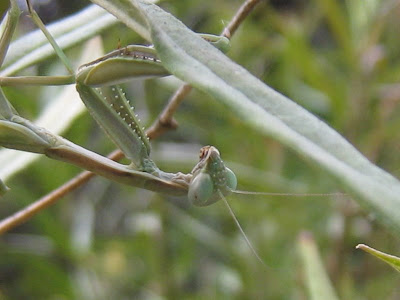
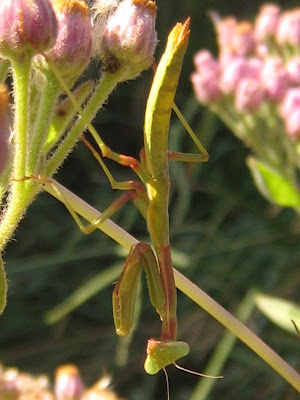
This Iris oratoria nymph is well camoflauged. This species predominates at the arboretum right now, and the next few pictures are all Iris.
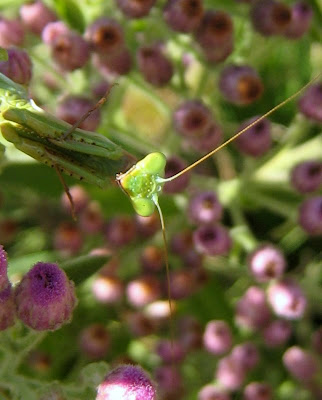
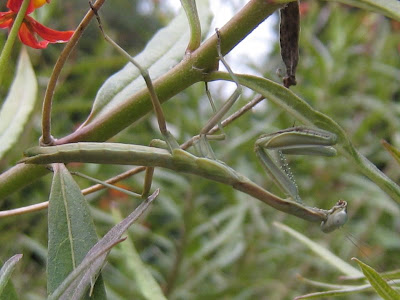
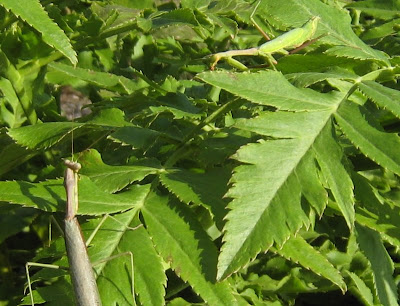
Also at the arboretum, S. limbata (I think) male and female encounter one another. They spent at least a couple hours checking each other out. By the next morning, the female had retreated under a leaf, but the male was still nearby. 2 days later, the male was still hanging around, but I couldn't see the female. I'm wondering if she was still there and I just couldn't see her, otherwise why would he still be there?
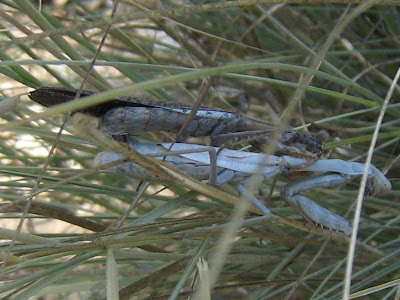
A pair of S. Californica mating in a clump of grass. The 2 males in the picture below were on a structure nearby, probably wishing it were them.

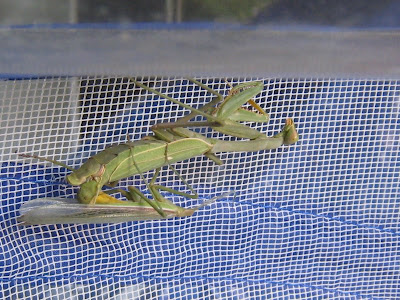
Meanwhile, back at my house, this fellow was not so lucky. I mean, he still got lucky, but lost his head in the process.
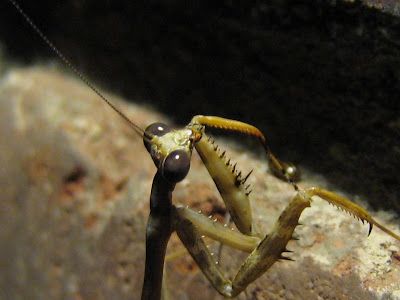
So often when I approach a mantid up close, it will turn its head and look right at me. Such was the case this time as well, and she gave me such a look, I had to caption it.


Here's a male S. Californica that came to my porch light.


This Iris oratoria nymph is well camoflauged. This species predominates at the arboretum right now, and the next few pictures are all Iris.


Also at the arboretum, S. limbata (I think) male and female encounter one another. They spent at least a couple hours checking each other out. By the next morning, the female had retreated under a leaf, but the male was still nearby. 2 days later, the male was still hanging around, but I couldn't see the female. I'm wondering if she was still there and I just couldn't see her, otherwise why would he still be there?

A pair of S. Californica mating in a clump of grass. The 2 males in the picture below were on a structure nearby, probably wishing it were them.


Meanwhile, back at my house, this fellow was not so lucky. I mean, he still got lucky, but lost his head in the process.
So often when I approach a mantid up close, it will turn its head and look right at me. Such was the case this time as well, and she gave me such a look, I had to caption it.

Subscribe to:
Posts (Atom)